
Circular Economy · Recycled feedstock
PIR vs PCR
and why it matters before you buy recycled pellets
"Recycled" on a quotation tells you very little. Pellets made from factory scrap and pellets made from used bottles carry different risks, count differently as recycled content and need checking in different places. This page covers the standard definitions, typical sources, variability, and how to state recycled content in a way that can be verified.
Marketing Department, ADVANCEDCHEM SOLUTIONS CO., LTD. · 22 October 2026 · about 8 min read
Definitions under ISO 14021
ISO 14021 covers self-declared environmental claims, and it is where the terms used across the recycling trade come from.
- Pre-consumer (in the trade often "post-industrial", PIR): material diverted from the waste stream during a manufacturing process and sent for recycling, such as runners, film edge trim or off-spec lots.
- Post-consumer (PCR): material generated by households, or by commercial, industrial and institutional facilities in their role as end users of the product, that can no longer be used for its intended purpose. This includes returns from the distribution chain.
- What does not count: rework, regrind or scrap generated in a process and capable of being reclaimed within that same process is not recycled content.
Two practical consequences follow. First, runners that your plant grinds and feeds back into the same machine are good waste reduction, but not recycled content. Second, "post-industrial" can mislead. Stretch film that a warehouse unwraps from pallets and throws away is post-consumer, because the warehouse is the end user of that film, even though it comes from an industrial site.
Typical sources
| Group | Example sources | Watch out for |
|---|---|---|
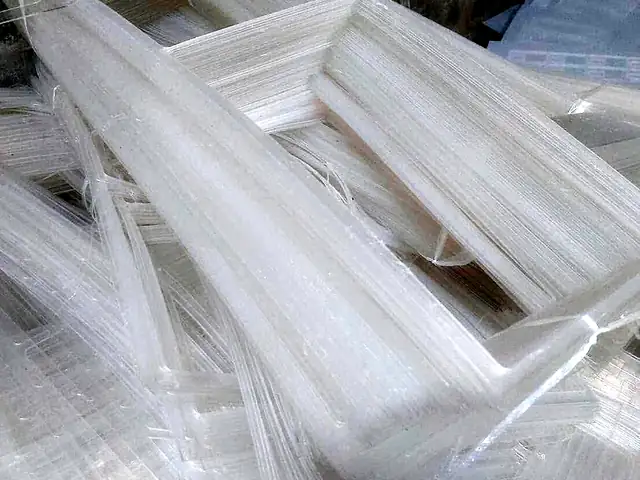
| PIR | Runners and sprues from injection moulding, edge trim and off-spec rolls from film lines, scrap from cap production, off-spec pellet or part lots | Purge lumps, mixed colours and grades, multilayer film (e.g. PE/PA) that cannot be separated, additives or fillers from the original part |
| PCR rigid packaging | HDPE milk and detergent bottles, PP caps, PET bottles, household tubs and containers | Labels and glue, caps of a different polymer, former contents such as food, detergent and oil |
| PCR durables and film | Crates, pallets, bins, stretch film and bags from warehouses and shops, agricultural film | Long sun and service exposure leaving little stabiliser, printing inks, soil, sand and moisture in film |
Contamination and variability
The two streams differ in history. PIR comes from a single source and has never been used. PCR comes from many users and has seen different amounts of sun, heat and contents. Both meet at intake and sorting, the first gate where quality is decided.
What makes PCR vary
- Mixed polymers: PE in PP or PP in PE from caps and labels. They do not mix into one phase, so parts become brittle and the surface can delaminate.
- Heat and sun history: stabiliser is consumed unevenly. Heavily degraded PP has a higher MFI; HDPE can form gels.
- Former contents: food, detergent and oil leave odour and volatiles that come out during melting.
- Solid contaminants: metal, sand, paper and fillers from the original part block screens and make ash content drift.
- Moisture: especially in film and in flakes after washing, causing bubbles and splay.
PIR is not risk-free either. Common issues are mixed grades, such as PP homopolymer scrap mixed with copolymer, mixed colours, and additives carried over from the original part, such as flame retardant or filler, that may be unwanted in the new one. Ask for the data sheet of the source grade whenever you can.
At the ACS Circular plant we set the incoming material specification and lot acceptance criteria with the customer before production starts: which sources are acceptable, what is tested, and which ranges each value must fall within. Sorting itself is covered in Sorting & preparation.
PIR vs PCR side by side
| Topic | PIR (pre-consumer) | PCR (post-consumer) |
|---|---|---|
| Source | Manufacturing scrap from another plant, never used | Products discarded by end users, households and businesses |
| Lot-to-lot consistency | Higher, if from one source and one grade | Lower; changes with source, season and collector |
| Contamination risk | Low to medium: mixed grades or colours, purge, multilayer film | Medium to high: other polymers, labels, glue, soil, metal |
| Odour | Usually low | Often an issue; depends on former contents and washing quality |
| Remaining stabiliser | Few extra heat cycles | Service life, sun and several heat cycles; often low |
| Availability | Limited by the source plant's output | Larger, but needs sorting and washing |
| Typical uses | Parts that need near-virgin consistency, blended in injection and extrusion | Crates, pallets, bins, pots, some pipe, and packaging where the brand owner requires PCR |
| What to ask the supplier | Source polymer and grade, the original data sheet, additives present, reliable monthly volume | Source packaging type, sorting and washing method, MFI, ash and moisture per lot, retain samples, source documentation |
Stating recycled content honestly
When a part is sold as "contains recycled material", the number must be traceable. If it cannot be verified, the claim risks being greenwashing, which brand owners and regulators in many markets are now checking more closely.
- Say which kind: report pre-consumer and post-consumer separately, not as one unexplained figure.
- State the basis: percent by weight of what, the plastic in the part or the whole pack including cap and label.
- Keep the evidence: feedstock purchase records, lot numbers and the blend record of each lot.
- Leave out in-house regrind returned to the same process.
- Avoid vague words like "eco-friendly" or "green" with no number or scope, and don't confuse "recyclable" with "made from recycled content".
If your end customer needs third-party verification, chain-of-custody schemes such as GRS / RCS, ISCC PLUS and EuCertPlast exist, and they have to be set up from the feedstock source. See how they differ in Standards & certification.
Blending PIR / PCR with virgin resin
Most plants don't run 100% recycled. They blend with virgin resin to hold MFI, toughness and colour. Principles worth keeping:
- Fixed ratio: use a gravimetric blender rather than hand mixing. A drifting ratio means a drifting blend MFI.
- Estimating blend MFI: for the same polymer, an approximate logarithmic mixing rule applies: log MFIblend ≈ Σ wi log MFIi (w = weight fraction). Use it only for PP with PP or PE with PE, never for mixed polymers, and confirm by measurement.
- Watch for segregation in the hopper: flakes and pellets differ in size and bulk density and flow differently. Use recycled material in pellet form where possible.
- Replace lost stabiliser: the higher the recycled share, the more additive package is needed. Reference ranges are on Recycled PCR.
- Record PIR and PCR shares separately for every lot to back up label claims.
The cost effect depends on the resin price gap, the cost of the package and any change in scrap rate. Try your own plant's numbers in the Cost-in-Use Calculator.
FAQ
Frequently asked questions
Does our own regrind, fed back into the same machine, count as recycled content?
No. ISO 14021 excludes material generated in a process and reused in that same process, such as runners or rejects that are ground and fed back into the machine that made them. Using regrind this way cuts waste and cost, but it should not be added to the recycled-content figure on a label.
Is stretch film from a warehouse PIR or PCR?
Under the ISO 14021 definition, material generated by businesses, shops or factories in their role as end users of a product is post-consumer. Stretch film unwrapped and discarded at a warehouse is therefore PCR, even though it comes from a commercial site. Edge trim cut off in the film plant itself is PIR.
Is PIR always better than PCR?
Not always. PIR is usually cleaner and more consistent, but some streams carry additives or fillers from the original part, or are multilayer films that cannot be separated by polymer, and some brand owners specifically require PCR. Choose based on the part specification and your end customer's requirements.
If we blend PIR and PCR in one formulation, how do we state recycled content?
Report pre-consumer and post-consumer shares separately and state the basis, for example percent by weight of the plastic in the part. Keep purchase records and the blend record of each lot as evidence. If your end customer needs a chain-of-custody certificate, follow that scheme's requirements from the feedstock source onwards.
Technical caution
Let-down ratios and technical data on this page are typical reference values, not a guarantee of properties. Confirm by trial in your own process before production use.
Send recycled feedstock samples for a free review
Send pellets or flakes from 2–3 lots with their source and the part you plan to make. Our technical team will suggest what to test and where the formulation needs to compensate. No obligation to buy.
Read next

Sorting & preparation
Sorting by polymer, colour and contaminant; grinding, washing and float–sink before extrusion.
Read more →
Formulation development
Replacing lost stabiliser, bonding mixed phases and setting targets from the part specification.
Read more →
Standards & certification
ISO 14021, GRS / RCS, ISCC PLUS, EuCertPlast and food-contact rules.
Read more →