
Circular Economy
Sorting and preparation
Recycled pellet quality is decided before the extruder
Whatever gets through sorting and washing ends up in every pellet, and most of it cannot be removed once it is melted together. This page walks through a preparation line step by step, from bale to clean flake: why each step matters and what each contaminant does to the pellets and the final part.
Marketing Department, ADVANCEDCHEM SOLUTIONS CO., LTD. · 22 October 2026 · about 9 minutes
Why preparation matters most
Melting combines; it does not separate. A melt filter only catches solids that do not melt. Another polymer that melts at the same temperature, such as PE in PP, mixes into the melt and there is no way to take it out at that stage. Odour and moisture can be reduced with vacuum venting, but not eliminated.
So most of what makes recycled pellets consistent (MFI, colour, odour, toughness) is decided at sorting and washing. Formulation and additives can compensate for part of it (see formulation development), but they do not replace clean feedstock.
Real lines order these steps differently depending on the feedstock: PET bottles, HDPE containers, PE film or PP parts. Some sort whole items by NIR before grinding, others sort flakes afterwards, and float–sink is usually part of the washing section. The sequence below is the general one used to explain the logic.
The preparation line, step by step
- Collection and baling Post-consumer material (PCR) often passes through junk shops and several layers of collectors before it reaches a recycler, and is pressed into bales for transport. Post-industrial scrap (PIR) is usually already separated by type at the source. Why it matters: what is in the bale sets the quality ceiling for the whole line. Agreeing a bale specification with the seller (polymer, colour, what must not be included) is cheaper than removing things later. See PIR vs PCR.
- Bale opening and pre-sorting A bale opener breaks the bale apart. Workers pick out wrong polymers, oversized items and containers that held hazardous chemicals. Magnets pull out ferrous metal and eddy-current separators remove non-ferrous metals such as aluminium. Why it matters: metal destroys granulator knives and screws, and any that reaches the pellets blocks screens or becomes a hard point that punches holes in thin parts.
- Size reduction (shredder / granulator) A slow-speed shredder tears large items; a granulator cuts them into flakes sized by its screen. Many lines grind wet to cut dust and knife wear and to start the washing. Why it matters: uniform flake size sorts, washes and dries evenly and feeds the extruder steadily. Very fine material (fines) is hard to wash and burns easily.
- Sorting by polymer NIR (near-infrared) sorters read the spectrum of each item or flake and eject the wrong ones with air jets. Float–sink tanks separate by density in water: PP and PE float, PET and PVC sink. Why it matters: different polymers that are melted together cannot be separated again, and they are the main cause of delamination and brittleness.
- Colour sorting Cameras separate clear or natural flakes from coloured ones and group the main colours. Why it matters: clear or natural flakes can be turned into any colour; mixed colours only go to grey or black. Colour differences between lots start here.
- Washing Cold or hot water, often with detergent or a caustic solution depending on the stream. High-speed friction washers scrub off sand, paper, label glue and food residue, and a second float–sink stage removes labels and foreign polymers. Why it matters: whatever is not washed out burns into black specks, blocks screens and causes odour. Washing uses water and energy and needs wastewater treatment, so it is one of the most demanding parts of the line to run.
- Drying First mechanical (centrifugal dryer or squeezer), then thermal with hot air. Film flakes are very light, so many lines densify them (agglomerator or compactor) before the extruder. Why it matters: leftover water turns to steam in the extruder, giving bubbles in pellets and splay on parts. In PET, water also breaks chains (hydrolysis) and lowers IV.
- Flake QC Moisture, contamination level, colour and bulk density of each lot before it goes to melting and pelletising. Why it matters: this is the last point where a lot can still be accepted, blended or rejected. After this, any problem is in the pellets.
Real examples: scrap after grinding
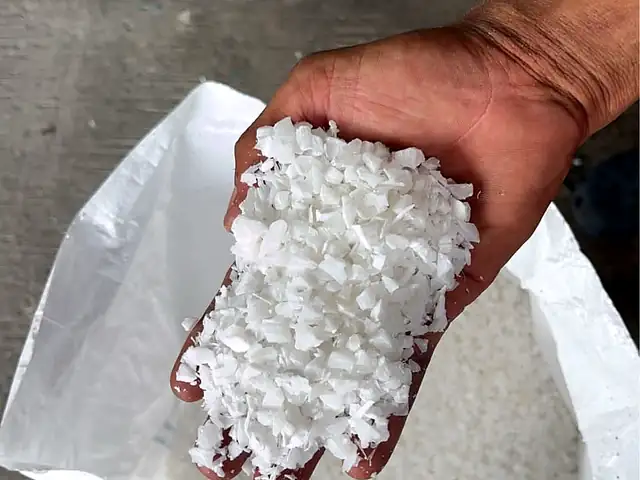
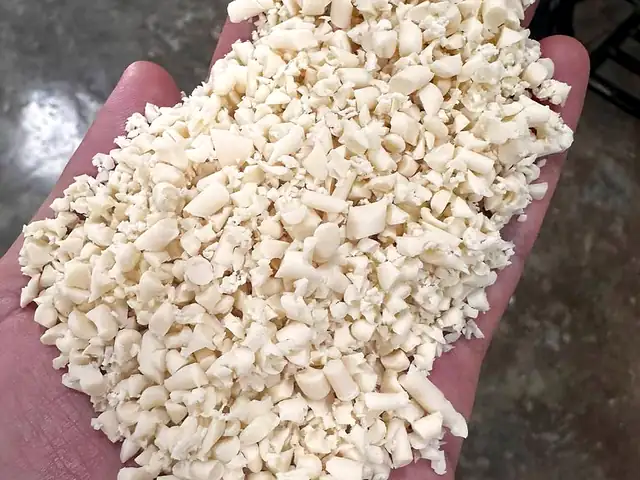
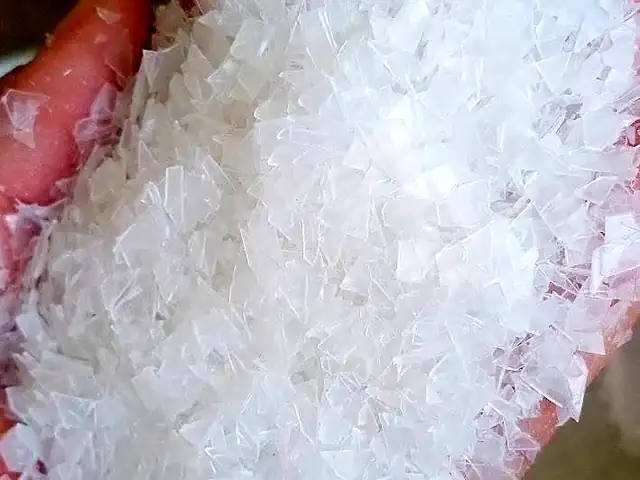
Regrind of even size and shape feeds the extruder steadily. Too many fines tend to burn and show up as black specks.
Density separation: what floats, what sinks
Float–sink uses the simplest principle there is: lighter than water floats, heavier sinks. Some lines use hydrocyclones, where centrifugal force makes the separation faster and sharper. The principle has limits you need to know.
| Polymer | Approx. density (g/cm³) | In water |
|---|---|---|
| PP | 0.90–0.91 | Floats |
| LDPE / LLDPE | 0.91–0.94 | Floats |
| HDPE | 0.94–0.97 | Floats |
| PS (solid) | 1.04–1.06 | Sinks (EPS foam floats) |
| PET | 1.33–1.40 | Sinks |
| Rigid PVC | 1.35–1.45 | Sinks |
| PP filled with talc or CaCO3 | Often above 1.0, depending on filler content | May sink with the heavy fraction |
Typical textbook values; they depend on grade, crystallinity and fillers.
- PP and PE both float, so water cannot separate them. Use NIR, or accept a blend and handle it in the formulation.
- PET and PVC both sink, so they need NIR or another method. This is critical on PET bottle lines.
- Air bubbles on flakes, foamed items and filled plastics make pieces float or sink in the wrong fraction.
- Standard NIR cannot read carbon-black items, because carbon black absorbs in this range, and on multilayer items it only reads the outer layer.
Contaminants and what they do to pellets
Each contaminant causes a different problem and is dealt with at a different step. Use this table to set incoming acceptance criteria and to trace the root cause when pellets go wrong.
| Contaminant | Effect on pellets and parts | How it is removed or controlled |
|---|---|---|
| PVC in PET | At PET melt temperatures PVC degrades and releases HCl: black specks, yellow pellets and faster PET degradation. Even very small amounts show. | NIR sorting of whole items and flakes; watch for PVC labels and sleeves; set a PVC limit in the flake spec |
| PET in PE or PP | PET melts at around 250–260 °C, above polyolefin processing temperatures, so it stays as hard particles: blocked screens, specks and holes in film | Float–sink (PET sinks) and a fine enough melt filter |
| PE in PP, or PP in PE | Two phases with weak adhesion: delamination, lower toughness, MFI off target | Cannot be separated in water; use NIR, measure the ratio by DSC (ISO 11357), handle the rest with a compatibiliser |
| Paper, labels, glue | Fibres burn into black specks with a burnt smell and block screens; glue makes flakes stick together and yellows pellets | Friction washing, hot washing, air classification after grinding; PP/PE labels on PET bottles go out in float–sink |
| Metal | Damaged knives and screws, blocked screens, specks or holes in parts | Magnets, eddy current, metal detectors before the granulator, and melt filtration |
| Sand, soil, glass, stones | Fast machine wear, high ash, rough surface, specks in film | Pre-wash, wet grinding, the sink fraction of float–sink; check ash (ISO 3451) |
| Moisture | Bubbles in pellets, splay on parts, lower viscosity in PET from hydrolysis | Mechanical and thermal drying, moisture check per lot, venting during melting, dry storage |
| Former contents (detergents, oils, food) and odour | Odour in pellets and parts; oily films hurt colour and print adhesion; some substances diffuse into the plastic | Remove chemical containers early, hot wash with detergent; what has diffused in must be handled during melting. See recycled pellets with odour |
| Printing inks and multilayer film | Off-colour, gels; PET, PA or aluminium layers in multilayer film are incompatible with PE | Standard washing does not remove print; keep multilayer film separate, use it for dark colours, filter finely |
| Filled plastics (talc, CaCO3) | Density and ash vary between lots; stiffer but more brittle | Check ash per lot, keep sources separate, count the filler already present before designing the formulation |
Checking flakes before melting
Every flake lot should have a minimum set of results before it goes into the extruder, so you can decide to accept it, blend it with other lots or reject it.
| Check | Why | Usual method |
|---|---|---|
| Moisture | Bubbles, splay, hydrolysis in PET | Weight before and after drying (loss on drying), or Karl Fischer where precision matters |
| Contamination | Black specks, blocked screens, delamination | Pick out and weigh foreign material from a weighed sample; press or extrude a plaque or film and count specks and gels; DSC for foreign polymers; ash |
| Colour | Sets which final pellet colours are possible | L*a*b* against a reference sample, or visual comparison in a standard light booth |
| Bulk density | Extruder feeding and throughput | Weigh flakes in a container of known volume |
| Flake size and fines | Steady feeding; fines burn | Sieve and weigh each size fraction |
Some recyclers also measure MFI on flakes to group lots before blending. Record the results per lot and keep a flake retain sample to compare against if a problem appears later. Measurements are done at a partner or external lab, or at the customer's QC.
What ACS controls
This page describes the industry process in general; it does not claim that every step happens in our plant. What ACS controls is:
- Incoming material specifications, agreed with the customer and the supplier: polymer, source (PIR or PCR), acceptable contamination, moisture and colour
- Lot acceptance criteria and test methods before material enters production
- Blending of several lots when the feedstock varies, with a reference sample kept from every lot
- A formulation designed to absorb the remaining variation; see formulation development
Circular grades are made in ACS's own plant (up to 3,000 t/year, being expanded). Our PCR / rPP compounds are sold under the Pure Earth brand. For the symptoms that typically show up when using recycled pellets, see recycled PCR with odour and unstable quality.
FAQ
Sorting and washing questions we hear often
Why can't a float–sink tank separate PP from PE?
Both are lighter than water (PP about 0.90–0.91 and PE about 0.91–0.97 g/cm³), so they float together. You either sort them by NIR before or after grinding, or accept a blend, measure the ratio by DSC and handle it with a compatibiliser in the formulation. When the part needs high toughness, sorting cleanly at the source usually pays off better than fixing it in the formulation.
Why can't NIR sort black plastics?
The carbon black used to colour plastics black absorbs almost all near-infrared light, so a standard NIR sorter gets no usable spectrum and cannot identify the polymer. Recyclers therefore usually keep black material as a separate stream or use a different detection technology. Black flakes suit parts that are black or dark anyway.
What is the difference between hot and cold washing?
Hot water with detergent or a caustic solution removes label glue, oil and food residue better and reduces surface odour more, but it uses more energy and produces more wastewater to treat. PET bottle lines typically wash hot, while many polyolefin film and container lines use cold water with friction washers. Choose by the contamination and the end use; hot washing is not always necessary.
The flakes are clean, so why do the pellets still smell?
Washing removes what sits on the surface, but polyolefins such as PE and PP absorb some organic substances, for example fragrances or oils from the former contents, into the bulk, and degradation of the plastic itself also creates odorous compounds. That part has to be handled during melting with vacuum venting and odour absorbers. Agree an odour criterion with the customer and measure it with an odour panel.
Technical caution
Let-down ratios and technical data on this page are typical reference values, not a guarantee of properties. Confirm by trial in your own process before production use.
Send us your recycled flakes or pellets
Send samples from 2–3 lots with the source of the material and the part it is meant for. We will help you see whether the problem is more likely in sorting, washing or the formulation. Free of charge, no obligation to buy.
Read next
PIR vs PCR
Factory scrap and post-consumer plastic differ in consistency and in how recycled content is counted
Read →
Formulation development
Engineering a recycled grade that is stable enough for the part: stabilisers, compatibilisers, colour and UV
Read →
From flakes to pellets & lot QC
Melting, filtration, degassing, pelletising and what is checked on every lot
Read →