
Knowledge Hub · Plastics processing series
Six ways to shape plastics
how the same pellet becomes very different parts
A bottle cap, a jerry can, a pipe, a food tray, a melamine plate and a water tank all start as plastic pellets or powder, but go through very different machines. This page compares the six main processes in one table, then takes you through each machine on its own page.
Where processing sits in the value chain
A plastic part goes through four stages: resin → additives → processing → part. Petrochemical producers make the base resin, additives and masterbatch tune its properties for the job, and converters turn it into parts. ACS works in the second stage. We do not mould parts ourselves, but knowing how each machine works is essential to choosing a formulation: time, temperature and shear differ so much between processes that the same additive can perform very differently.
The six processes compared
| Process | Shape made | Typical parts | Main resins | Tooling cost | Output speed | Economic volume | Wall-thickness control |
|---|---|---|---|---|---|---|---|
| Injection molding | Solid, complex 3D parts | Caps, boxes, crates, automotive and appliance parts | PP, HDPE, ABS, PS, PC, PA | High | High | High | Very good, set by both mould halves |
| Blow molding | Hollow parts with a narrow neck | Bottles, jerry cans, chemical drums | HDPE, PP, PET | Medium | Medium to high | Medium to high | Moderate, via parison or preform control |
| Extrusion | Constant cross-section, continuous length | Pipe, profile, sheet, film, cable | PE, PP, PVC | Low to medium (die) | High, continuous | High | Good across the section |
| Thermoforming | Thin-walled, open shapes from sheet | Cups, trays, blisters, clamshells | PS, PP, PET, PVC | Low to medium | High | Low to high | Limited; walls thin out at corners and deep draws |
| Compression molding | Flat or thick parts from thermosets, rubber or composites | Melamine plates, rubber seals, electrical insulators, SMC panels | Thermosets (phenolic, melamine, UP/SMC), rubber | Medium | Low to medium (curing time) | Medium | Good, suits thick sections |
| Rotational molding | Large, seamless hollow parts | Water tanks, kayaks, wheeled bins | LLDPE / MDPE powder | Low | Low | Low to medium | Moderate; fairly even walls, corners tend to be thicker |
How to choose a process
Start with the shape of the part, then look at volume and material. These questions narrow the options quickly.
- Hollow with a narrow neck, such as bottles and jerry cans: blow molding. Very large and low volume, such as water tanks: rotational molding.
- Same cross-section along the whole length, such as pipe, profile, sheet or film: extrusion.
- Thin-walled and open on one side, such as cups and trays: thermoforming from extruded sheet.
- Complex 3D shape, tight dimensions and high volume: injection molding.
- Thermoset, rubber or composite material: compression molding.
- Volume versus tooling cost: an expensive mould pays off when spread over many parts. At low volume, a process with cheaper tooling may give a lower cost per part.
- Resin grade follows the process: injection uses higher-MFI grades; blow molding and extrusion use low or fractional MFI so the melt can support its own weight; rotational molding uses powder ground from dedicated grades.
The process also decides how additives go in. Injection, blow molding and extrusion can dose masterbatch at the hopper throat. Rotational molding uses powder, so additives usually have to be compounded into the pellet before it is ground. Details are on each process page.
One process at a time

Injection molding
The screw melts and injects; clamp force, gates, and why cooling dominates the cycle
Read more →
Blow molding
Bottles, jerry cans, drums: air inflates a parison or preform against the mould
Read more →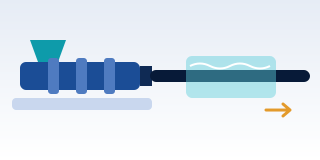
Extrusion
Pipe, profile, sheet, film: melt pushed continuously through a die
Read more →
Thermoforming
Cups, trays, blisters: heated sheet drawn or pressed onto a mould
Read more →
Compression molding
Thermosets, rubber, composites: material pressed in a hot mould until it cures
Read more →
Rotational molding
Water tanks, kayaks: powder melts and coats a mould rotating in an oven
Read more →Not sure which additive suits your machine?
Tell us your process, resin grade and the problem you are seeing. We will help you match a formulation to your machine conditions. No charge.